I have a “thing” about sleep. I want it. So, I don’t know what I was thinking when someone from the medical team assisting with my physical suddenly asked, “Do you snore?”
The question took me back to the previous night when my husband, Dennis, told me “You know, you were snoring”, so I told her that, thinking it was funny.
That little tidbit landed right on my doctor’s radar, and suddenly she had me scheduled for a sleep study (polysomnography.)
She saw the look I gave her and said, “Don’t worry! You don’t have to sleep in some specialized lab somewhere with someone watching you. We’ll give you equipment and you can do it in the comfort of your own home.”
The test tries to determine whether a person has sleep apnea, which can be serious. For those unfamiliar, it is a condition where breathing repeatedly stops and starts throughout the night. This can affect the body getting enough oxygen, which is a health risk for high blood pressure, atrial fibrillation, or heart attack. Snoring or suddenly waking up gasping or coughing are also symptoms.
To correct this, I think many people are aware of the CPAP (Continuous Positive Airway Pressure) machine where the sleeper wears a mask attached to a unit which delivers constant air to keep the airway open. We probably all have family and friends who use them.
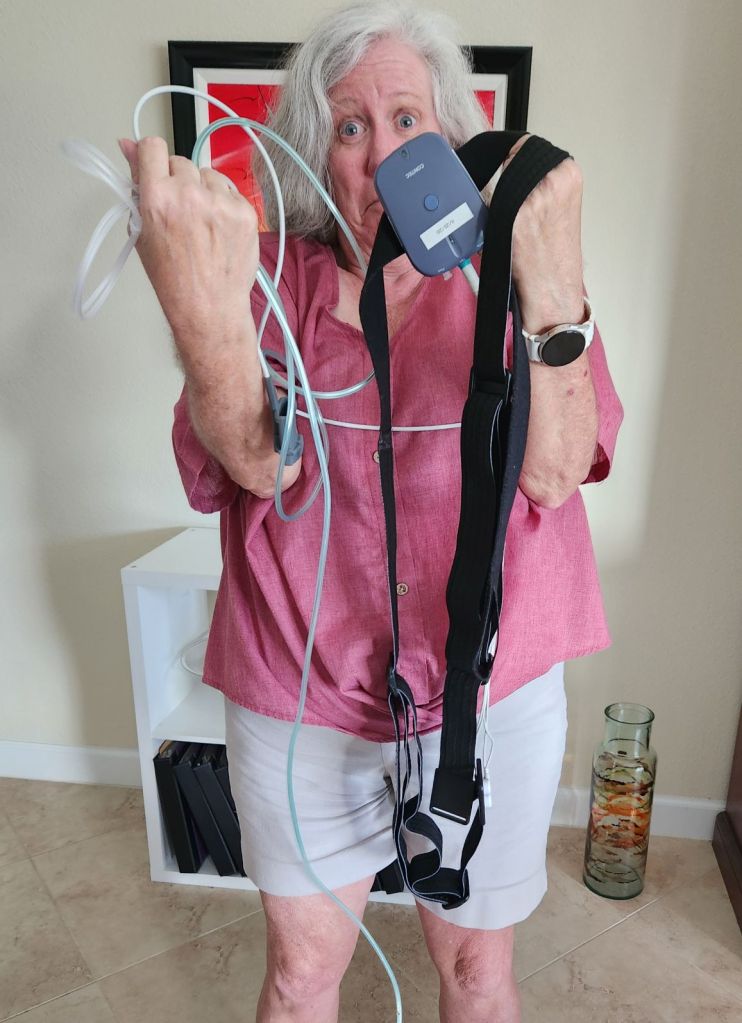
On the big day, I went to pick up the study equipment. I looked at it with great suspicion. There were two Velcro belts to be placed on the upper and lower chest, with two leads each. They fed into a sleep apnea screen meter strapped into the upper chest belt. There was a rubber pulse oximeter sensor, also attached with a long cord to place on one finger. Its role is to measure the percentage of oxygen traveling through your red blood cells all night. It can detect when your oxygen dips.
I also received a nasal cannula (you know, in those medical shows where the patient has a clear tube tucked behind each ear, and tiny nasal prongs placed in each nostril) and SEVEN feet of oxygen tubing completed the kit. I was pretty sure that I would trip on that in the night when I got up.
The nurse explained each function and positioning, but I think she was speaking in Latin. Luckily, she emailed a link to a video that I must have watched parts of, rewound, and watched again 6-7 times.
If anyone has a sleep study in their future, I found it helpful to do a dry run and figure out the positioning of everything and placement of leads before dinner and not at bedtime. I just carefully removed everything and laid it on a table.
The prep became a family affair.
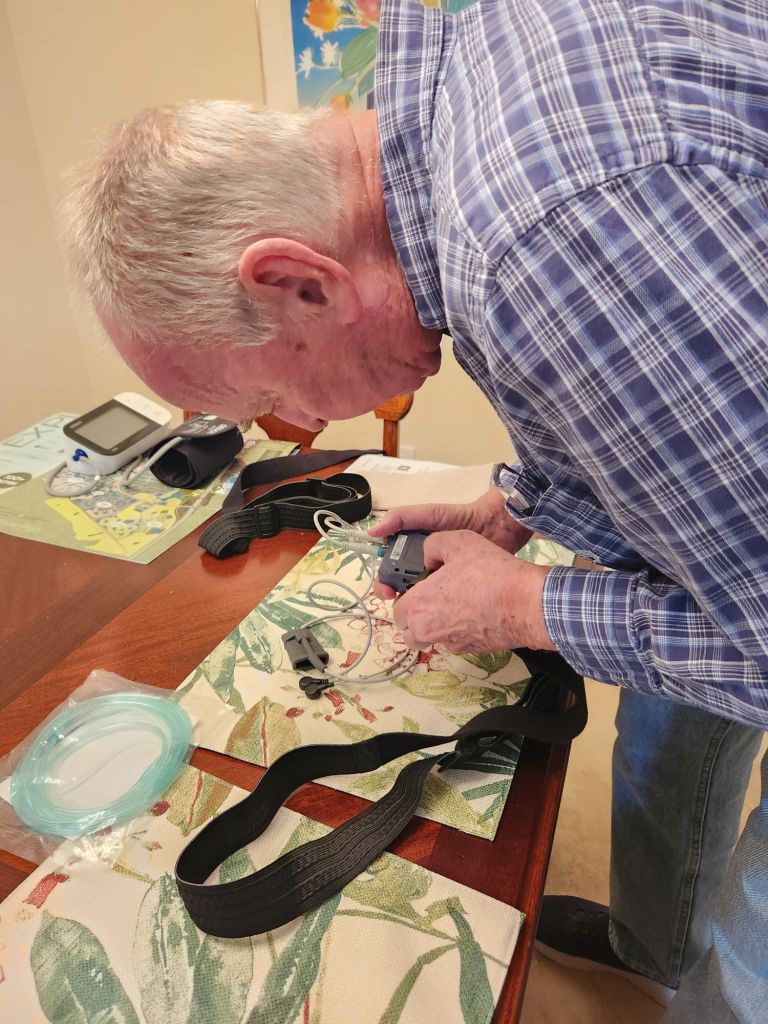
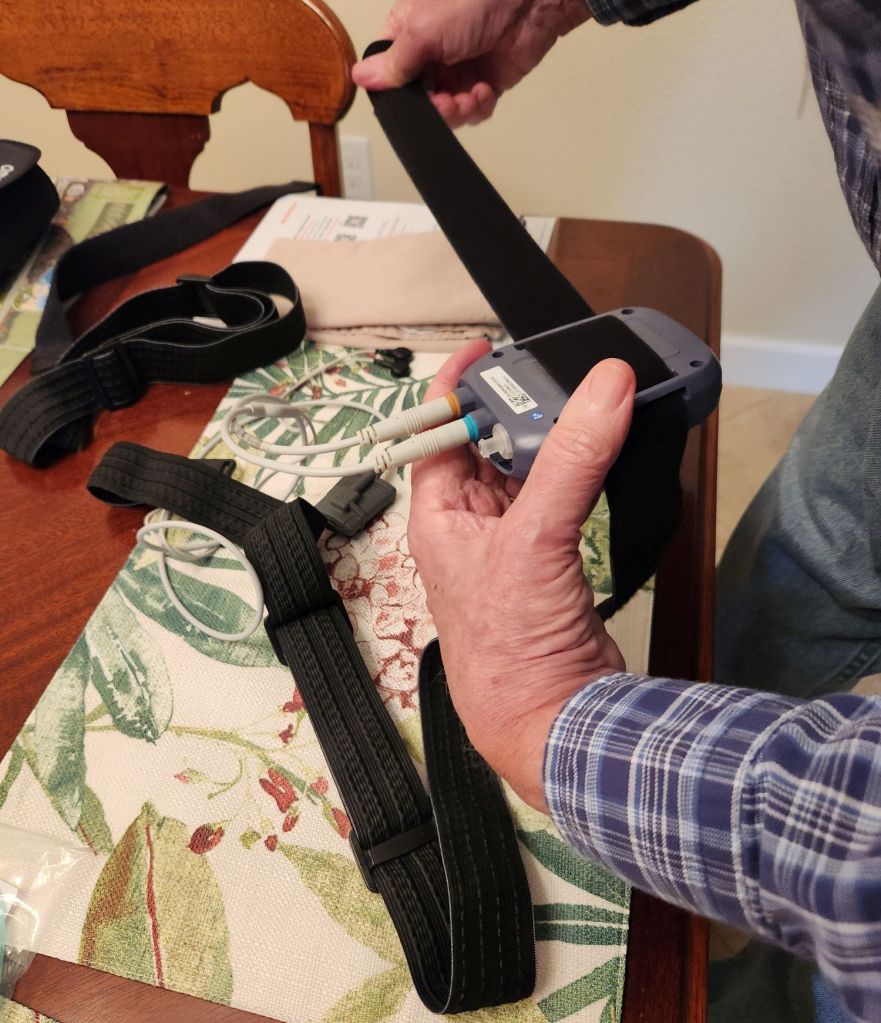
Strapped in later, I lay down to sleep. Naturally, sleep didn’t come. I started on my right side and instantly had to figure out how to bury the green blinking light on the box; blinking in my face. Carefully placing the covers over the device, did the trick.
I still wasn’t asleep, so I carefully rolled over on my other side, carrying the tubing with me.
At some point, I thought It’s beginning to sink in that I may not sleep at all. They have to know that all of this paraphernalia actually prevents the patient from sleeping!
I rolled again. I decided to take a regular Tylenol.
Somewhere in there, shockingly, I slept. Once when I got up to drink some water (carefully carrying all that plastic tubing with me so I wouldn’t trip), I returned to the bedroom, where Dennis was awake. As I walked, and especially as I tried to climb into bed, he said the blinking green light shining up on the ceiling looked like a moving spotlight in a prison yard doing a sweep. He always makes me laugh.
At 5:15 a.m., I got up and took it off. By my calculation, it recorded almost six hours. I’m pretty sure that’s enough. I tried to return to sleep, but I couldn’t. Then I returned the equipment later that morning.
The American Medical Association estimates that 80% of moderate-to-severe sleep apnea cases remain completely undiagnosed. The snoring has to wake you up so you know (or a bed partner will likely let you know.)
In severe cases, a person’s breathing can stop over 30 times every single hour, totaling hundreds of episodes a night. Each time, the brain triggers a microscopic jolt of adrenaline to wake the body up just enough to gasp for air, meaning the person never enters deep, restorative REM sleep.
Thankfully, I’m not there. Dennis told me my occasional snoring habits don’t bother him. They don’t bother me either, so we’ll have to hear the results. And then I will decide on the next step. But first, I’ll sleep on it.


Leave a Reply