I had finished weeding around the begonias in my grandfather’s garden as I did sometimes on Saturday mornings. I knew that he would be waiting inside for me. I was nervous about going in because I had something on my mind. I was 16 or 17 years-old.
After he placed a cold bottle of Coca-Cola in front of me on the breakfast table and sat next to me, it was time to ask a question I had wanted to ask for a long time:
“Billie, would you be able to paint a painting specifically for me?”
As many of you know, “Billie” was William C. Grauer, a well-respected artist and teacher who was born in Philadelphia but had made Cleveland, Ohio his home. (Starting in the 1920s, many artists were gravitating there because of its growing, influential art scene.)
My dream had always been that my grandfather would visualize me, the silliness we shared, but the earnestness too, and somehow get that on canvas. I was not asking for a portrait, just a scene or an abstract that spoke to his granddaughter’s spirit. I wanted to see how he saw me in his world of shapes and colors.
“Oh,” he replied. “I could try to think of something that might work.”
Elated, I said, “I would love that, thank you.”
So, one afternoon when Mom and I were sitting in his living room, Billie suddenly stood up. When he returned, he was carrying a framed painting; its size was roughly 33 x 28 inches.
“Here you go, sweetheart. You requested an original Grauer, and I picked this out for you.”
I am embarrassed that my initial reaction was disappointment. I could see that he hadn’t fully understood my question. He had chosen a painting that already existed. But to be fair, I could see where my words weren’t crystal clear, plus I had been nervous.
It was a watercolor scene from his beloved Mexico. There was a small mountain in the background with its peak shrouded in clouds. It included a pinkish adobe, and in front of that was a man on a horse, and another tending to a bull. The last man was carrying a basket and using a walking stick.
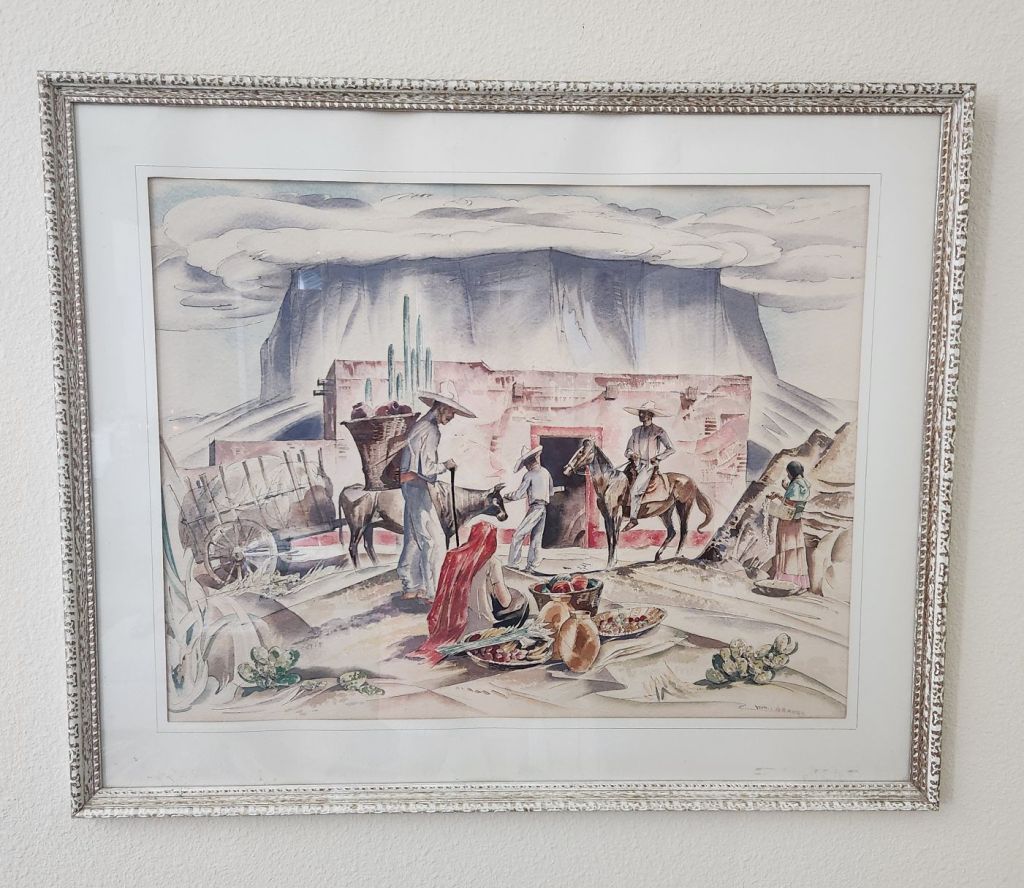
There were also two women working; the woman seated was wearing a long, red shawl; maybe to protect herself from the sun.
Gazing at it, my heart sank. Although I was glad it was a watercolor and not a pencil sketch, the scene was not interesting to me. How in the world did he see me in this?
Of course, I was absolutely polite. I openly accepted it and, with his help, carefully placed it in the car’s backseat. I thanked him with a hug.
Privately, I remained irritated with myself. I understood that this was a request that could not be repeated. I was sad that I felt no connection to the painting’s content. But I would forever be loyal to it and keep it, knowing he had given it as a gift.
Sometime later, I had learned the truth from Mom.
“I’m not sure you ever knew or paid attention to the title of the painting,” she said when the topic came up.
“What? No, I don’t think he told me the title that day,” I replied.
“Well, go upstairs and turn it around; the title should be on the back,” she suggested.
I ran upstairs and turned it.
“Mesa in the Clouds,” I read loudly so Mom could hear.
“Daddy thought about your request, and ultimately decided on this painting,” she shared. “Yes, it’s an old painting, but he felt you in it.”
I walked back down the stairs, a little incredulous. “I don’t see myself in it at all,” I replied.
“When you were younger,” she continued, “you had all kinds of crazy ideas and did some crazy things, too.” (My thoughts went to tasting turpentine once and always climbing up a tree in my backyard to read my library books.) I could sometimes be all over the place.
“He told me he thought you were the granddaughter with her head in the clouds, a daydreamer who was not always practical; and you loved to escape into those daydreams as often as possible” Mom explained.
And then I understood. I had been looking at it in a literal sense; the physical figures and what they were doing; standing, sitting, cooking, tending. I had focused on the surface stuff. But he had been looking at the background of the painting and it drew him in. It was an emotional connection.
Was the connection based on what he was thinking about when he first painted it? I don’t know. Or, did he imagine me as a figure on the mesa, doing what I do, not ready to return to real life, like the scene below? I don’t know that either.
I’ll admit that identifying me as impractical felt uncomplimentary, but he definitely felt or recognized my need to get out of my real world; to escape into my daydreams. This realization shocked me. I had no idea that he was onto me. Somehow, the eyes of this artist had looked between the spaces and shapes in his world and found the girl who liked to hide.


 Leavingthedooropen.com
Leave a reply to Anonymous Cancel reply