Am I a carnival nerd? Maybe. I went online to buy stamps a few months back and saw this new collection.
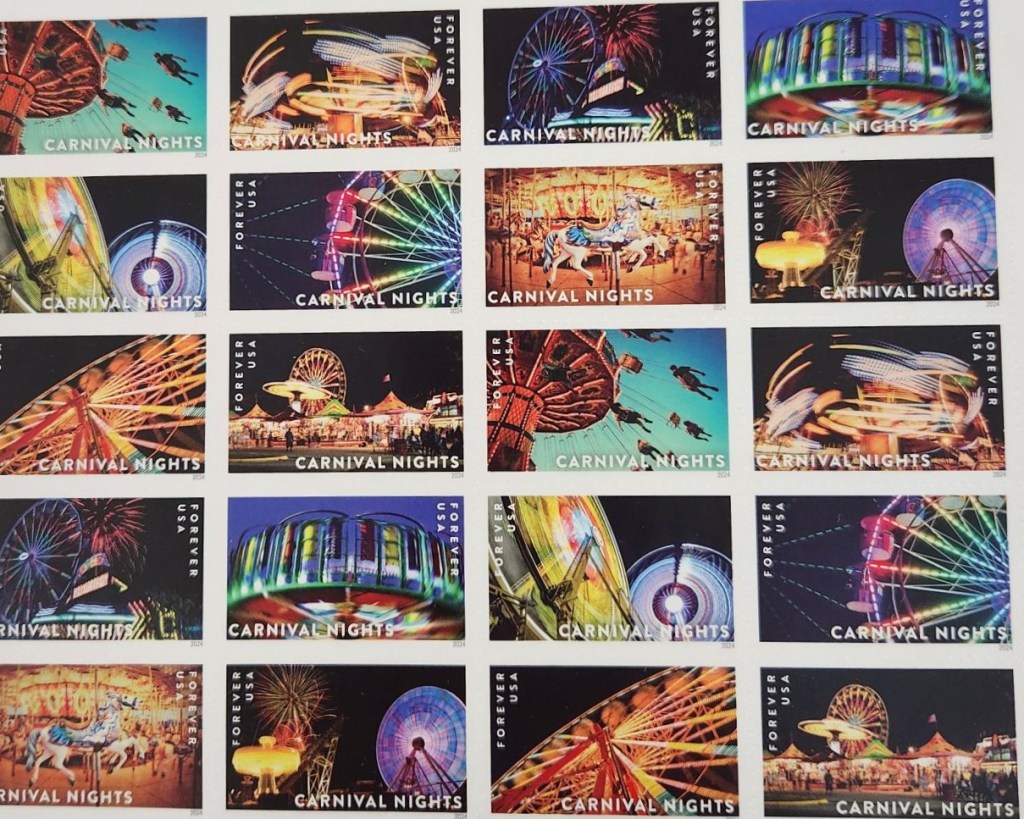
I immediately placed them in my cart. How can you ignore beautiful images of a carnival at night with a dozen moving colors inside a Ferris Wheel or the beckoning lights of the Midway? These designs are just teeming with nostalgia. Look closely and you may place yourself in the scene and smell the popcorn and frying dough and hear the ding-ding-ding of the games and shouts of excitement from the crowd as their rides begin.
I thought, “Well, I’ll just look up a little something about carnivals to share” and wham! I was shocked to learn that the Chicago World’s Columbia Exposition held in 1893 is actually considered the catalyst to what are now traveling carnivals in the U.S.
How did I miss this? I had written an entire post about the Chicago’s World Fair several years ago and my utter fascination with it. But I never connected this unprecedented undertaking with the birth of the American carnival. Here’s a link to that World’s Fair post.
But I had missed something; understanding the affect of the “Midway Plaisance” portion of the World’s Fair. As guests walked the mile-long Midway east towards the entrance to Jackson Park, they had immediately felt the sights and sounds of over 40 exhibits. It took them somewhere else. There was the California Ostrich Farm, the Austrian Village and the Captive Balloon Park, which offered balloon rides, and the Ferris Wheel. They could also ride the Ice Railway “a descending elliptical track of ice over which 2 coupled bobsleds could reach speeds of 40 miles an hour.”
One attraction called “Street in Cairo”, had brought in on a ship, 175 residents of Cairo, 20 donkeys, 7 camels, monkeys and deadly snakes! It included a Persian concession, a Moorish palace, and an Algerian Village whose belly dancing performances were wildly popular.
And that’s the point. The entire Midway Plaisance was so popular, and visitors loved the simple novelty and joy, that a man named Otto Schmitt, a showman at the fair, formed the Chicago Midway Plaisance Amusement Company. It featured 13 acts, including some from the World’s Fair and began a tour of the Northeast U.S. when the Fair closed.
Although his company closed because of poor business practices, some members of his company founded successful traveling carnivals of their own.
In 1902, there were 17 traveling carnivals in the U.S. The number grew to 46 in 1905; by 1937 there were about 300 carnivals touring the country. The term “Midway” was adopted from the Midway Plaisance to denote the area at county and state fairs where sideshow entertainment was located. (Credit: Wikipedia.)
There are no more belly-dancing or deadly snake acts, but traveling carnivals did adopt the most famous symbol of the Columbia Exposition: the Ferris Wheel. George Ferris designed and built it specifically for our World’s Fair to outdo Paris and its Eiffel Tower; developed for its own World’s Fair. It’s pretty much the mainstay of any decent traveling carnival.
Ok. I guess that I am officially a carnival nerd. I don’t eat cotton candy anymore, but I will buy shaved ice in a cone and stroll the games of chance. I won’t but a ticket for the Scrambler, but I’ll sit and listen to the live bands.
As someone who once picked the 1893 World’s Fair as the number one place where I would want to time-travel to, now I understand why my soul is perennially drawn to a carnival; it’s a nostalgic piece of my time-traveling fantasy. The two are actually one. My head still pivots when I see a “The Fair is coming to town” sign.
Since it’s officially May now, the carnival season is already opening up in many states. If you can, take a ride on the Ferris Wheel this summer and look down and back at the nostalgia all around you.


 Leavingthedooropen.com
Leave a reply to Victoria Cancel reply