I was twelve when the original The Poseidon Adventure movie was released in 1972. Although I was mesmerized by the man falling into the gigantic stained-glass skylight as the boat turned upside-down, it was the giant wave itself that permanently imprinted on me. Whether real or on-screen, the raw, indisputable power of water rising up has sucked me in for over 40 years.
I have watched every movie claiming to have the tallest or scariest CGI wave on film (more on that later.) I have read books about waves such as “The Wave: In Pursuit of the Rogues, Freaks, and Giants of the Ocean” by Susan Casey and “The Perfect Storm” by Sebastian Junger.
For humans, there is some kind of primal attraction to waves. They are visually beautiful when that pipeline forms and the curl starts to climb. They are hypnotic when they make that sound as they break on the shore. Watching them is a perfect doorway into soul-searching.
But in certain conditions such as storms or earthquakes, these beautiful acts of Mother Nature can get twisted up into monsters. People are drawn to that dichotomy. Just check out the endless video options on YouTube when you type in “large waves.” Or, look at the long history of successful monster wave movies like Deep Impact, The Day After Tomorrow etc. We come to the shoreline and the movies, afraid and fascinated, to see exactly how large and destructive waves can become.
Does anyone know where the love of God goes
When the waves turn the minutes to hours?
The truth is monster waves don’t have to be as large as you might imagine, and they don’t have to be from the ocean. Another early exposure I had to a story on deadly waves concerned the real-life event of the sinking of the S.S. Edmund Fitzgerald in 1975. I lived close to Lake Erie, and although the ship sunk in Lake Superior, reports of such catastrophes were always frontpage news for those who lived in the Great Lakes region.
She set sail on November 10th from Superior, Wisconsin and was headed to a steel mill near Detroit. A horrific storm which had started as a low-pressure system in Kansas bore down on the lake with hurricane force winds. It had been predicted to pass south of the lake. These winds generated 35-foot waves. Another ship in the area contacted the captain by radio and he mentioned there was damage but said “we are holding our own.” That was the last anyone heard from her. No distress signal was received, and within minutes the other ship lost the Edmund Fitzgerald on radar.
Years later, scientists ran a simulation of weather conditions for that day and suspect its demise was based on a group of three rogue waves, often called “three sisters,” which had been reported in the vicinity of Edmund Fitzgerald at the time she sank. First, this set of three waves are one-third larger than an average wave which means more weight. The first wave hits and deposits that weight onto the deck. It can’t clear before the second wave hits only burying the deck more. The third wave overloads the ship and it can’t recover. Iron ore carriers are particularly susceptible because they lie very low in the water. The waves generally break the first and second hatch covers.
29 men lost their lives. Gordon Lightfoot made this story famous with his legendary 1976 song: “The Wreck of the Edmund Fitzgerald.” Here’s a verse:
When suppertime came, the old cook came on deck sayin’ “Fellas, it’s too rough to feed ya”
At seven PM, a main hatchway caved in, he said “Fellas, it’s been good to know ya”
The captain wired in he had water comin’ in and the good ship and crew was in peril
And later that night when his lights went outta sight came the wreck of the Edmund Fitzgerald…
..The searchers all say they’d have made Whitefish Bay If they’d put fifteen more miles behind her
“Waves are not measured in feet and inches, but in increments of fear.” Big Wave Surfer Buzzy Trent
Susan Casey’s The Wave mixes wave history, science and a good deal of first-person reporting on extreme surfers and their passion to find and surf the largest waves in the world. They scour global weather reports and report to each other where the waves are and then travel to various locations world-wide at a moment’s notice.
Surfing giant waves was not even possible until the concept of tow-in surfing was born. Tow-in surfing is a surfing technique when the waves are so large that the surfer needs to be towed in with a Jet Ski to get into place. Paddling by hand won’t work in the larger, faster moving waves. Tow-in surfing was co-invented by Laird Hamilton who wanted to catch bigger waves and break the 30-foot barrier (9 m).
Casey embedded with a few extreme surfers, including Hamilton, to not only capture the pulse of the chaotic lifestyle as they hightail it to surf hot spots such as Maui’s Jaws or Egypt or Teahupo’o, Tahiti, but she wanted to watch them surf; albeit safely from a nearby boat.
Although she wasn’t on site when Hamilton surfed the largest wave in his life on Dec. 3rd 2007 on Maui’s Egypt, she shared the compelling story. First, his friend had successfully towed him in and Hamilton rode a monster wave, deciding last second that it was safer to cut through the wave near the end to the backside. As his friend went to retrieve him, they realized that the next wave was an 80-foot beast and it was on top of them. It pushed them under hard, then blasted the Jet Ski into the air and landing on his friend’s leg slicing it open and breaking it. Hamilton took off his wetsuit to use as a tourniquet and got him back to shore. But that wasn’t it. Once his friend was in the ambulance, he turned towards his companions and said that they needed to see what was happening out there. He wasn’t done. He needed something to turn the traumatic day upwards.
Don Shearer was there. Shearer is a helicopter pilot who has rescued people out of flash floods and riptides and the backcountry of Hawaii for 35 years. He often flies “safety” for those in the water. He told Casey that “Hamilton was jacked beyond jacked. He was on a mission. “
And Hamilton was right about the waves. “I fly everyday with a 100-ft line (30.48 m) on my helicopter and I’m very good at judging height. I have to be. And I KNOW for a fact – it was over 100 feet out there. GUARANTEED. I’m even saying one-ten, one-fifteen.”
Shearer was on a Jet Ski and watched while Hamilton was towed into position “I watched Laird release the rope and then I saw him come down this wave…I’ve never seen anything like it in my life. The whole reef drained. And the energy the wave had taken to jack itself up created this trough…and Laird’s on the face and the reef is drained off and there’s this THING behind him. And I saw it! I saw the Big Mother.”
Scientists say that freak or rogue waves depend less on rough seas or windy conditions to form and more on the measure of how wave energy is distributed in a given area. It comes down to steepness. Steep waves are further from equilibrium: less stable, and are more prone to pirating other wave’s energy, increasing their power.
Official records for surfing state that Garrett McNamara holds the record for surfing the largest wave Jan. 28th, 2013 off the Praia do Norte beach in Nazaré, Portugal. It was 78 feet (23.77 m.)
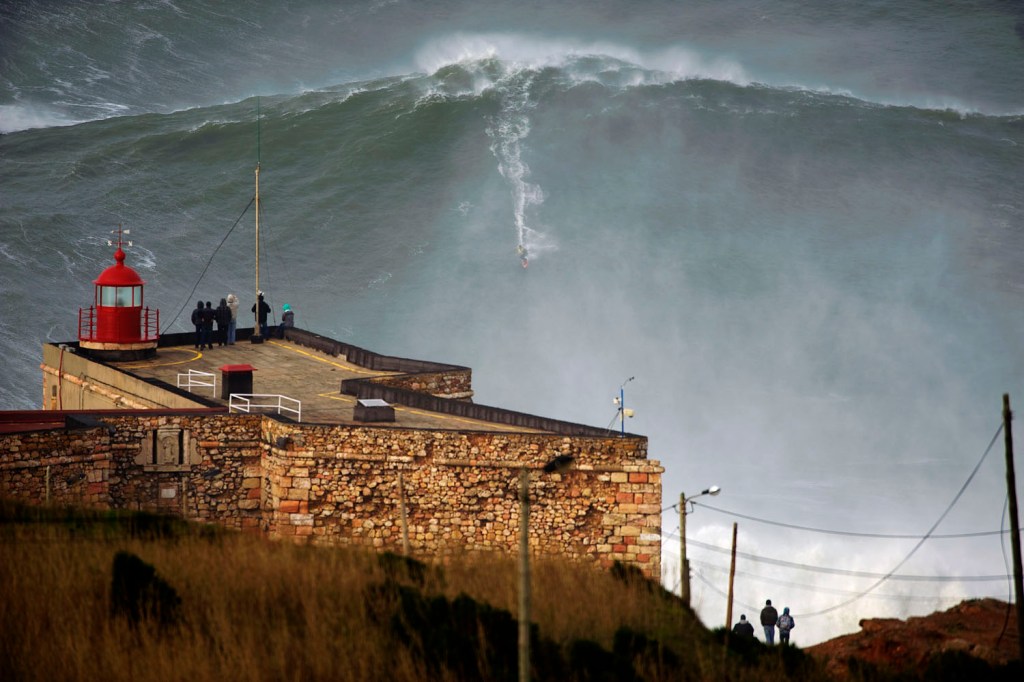
The current women’s world record is held by Maya Gabeira at 73.5 feet (22.4 m) which she surfed at Praia do Norte beach on February 11, 2020.

A True Story of Men Against the Sea
100-foot freak waves are not fiction. On Oct. 30, 1991, a buoy off the coast of Nova Scotia reported a wave height of 100.7 feet (30.7 m), the highest ever recorded in that province’s offshore waters during a fierce storm. This was the same infamous nor’easter which sank the fishing vessel Andrea Gail, killing her crew of six. It inspired the book The Perfect Storm and the subsequent movie. Nor’easters are common in this area, but what made it a super storm was that remnants of Hurricane Grace were still in the region and the nor’easter absorbed it; the warm air putting it on storm steroids.
There is no proof that a 100-foot wave took the ship, other reports that surfaced showed waves at 39 feet with sustained winds of 56 mph with gusts to 75 mph. The movie’s version of the wave, however, absolutely towered over the ship and was truthfully almost disturbing to watch because it felt so real and you knew they weren’t going to make it.
According to a salvage expert in The Wave, “It takes 30 tons per square meter of force to dent a ship. A breaking 100-foot wave packs 100 tons of force per square meter and can tear a ship in half.” Even at 50-feet, the smaller Andrea Gail didn’t stand a chance.
“What is perhaps more worthy of note than how many tsunami dead we’ve seen, however, is how many other recent dead we have not seen.” Bruce Jackson
Tsunami is a Japanese word loosely translating to “harbor waves” (because they can’t be seen until they are close to land.) It is not a single, horrific wave, but rather, a horrific parade of them. They are created when there are earthquakes and landslides pushing the water vertically. It becomes an intensity of energy that reaches all the way to the ocean floor shooting off in every direction.
For some reason, some choose to interchange “tsunami” with “tidal wave” but they are not the same. According to The National Oceanic and Atmospheric Administration (NOAA) “a tidal wave is a regularly recurring shallow water wave caused by effects of the gravitational interactions between the Sun, Moon, and Earth on the ocean…tsunamis have nothing to do with the tide.”
I clearly remember the tsunami which hit the Indian Ocean on Dec. 26, 2004. That footage of raging water rushing towards a hotel, as people stood back in disbelief, then getting caught up in it is frightening. This disaster was also made into the 2013 film The Impossible. This is a still shot taken from video on that day:

It was triggered by a mind-numbing 9.1 earthquake off the coast of Sumatra Island, Indonesia. The size of the quake created waves that affected at least five countries with a death total over 230,000.
In April 1916, polar hero Ernest Shackleton shared a harrowing experience in his ship’s log on his crossing from Antarctica to South Georgia Island. Shackleton noticed odd movements in the night sky. “A moment later, I realized what I had seen was not a rift in the clouds, but the white crest of an enormous wave” he wrote. When the wave hit his ship, he and his crew were “flung forward like a cork” and the boat flooded. “Earnestly we hoped that never again would we encounter such a wave.”
But too many others have since that entry. The European Space Agency satellite system has shown that severe weather has sunk more than 200 supertankers and container ships exceeding 650 feet in length during the last two decades alone! Rogue waves are believed to be the major cause in many such cases.
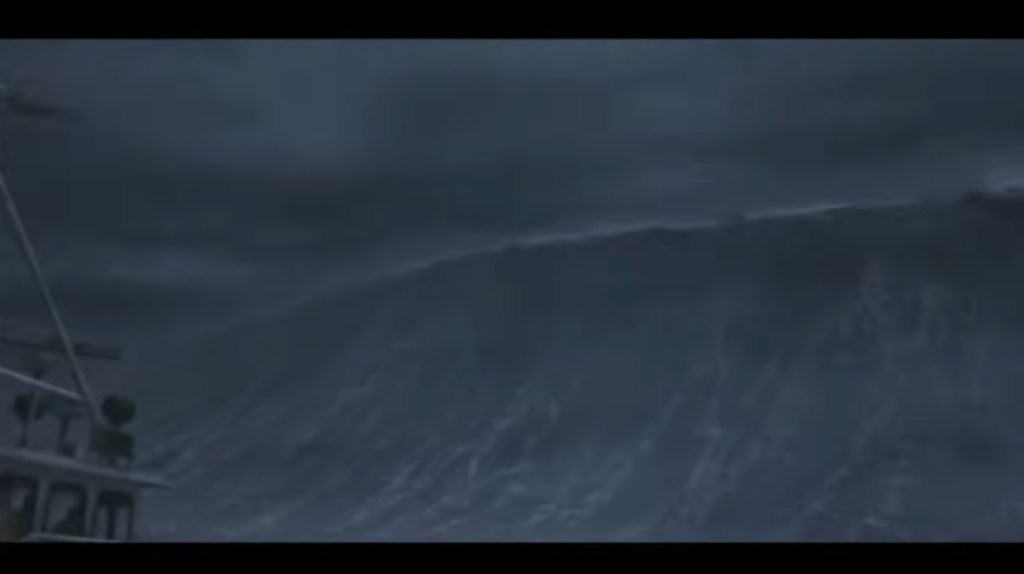
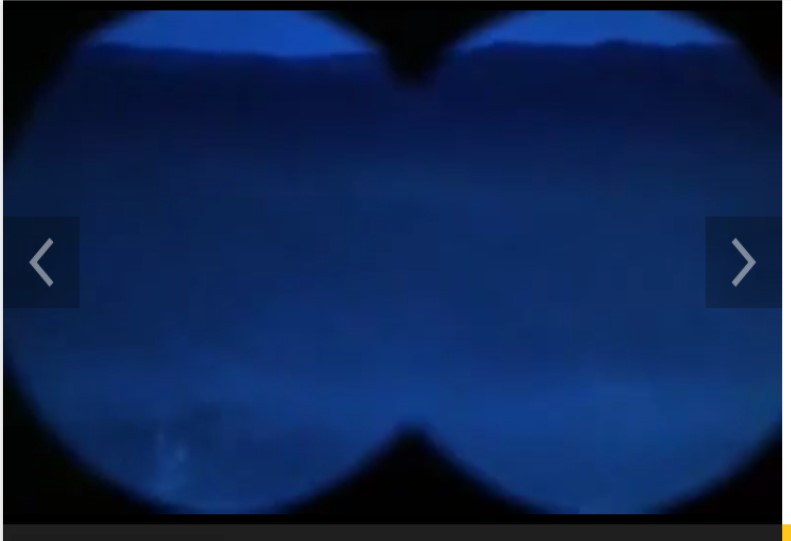
Movie directors try and help us visualize, or perhaps just scare us, with the scale of waves they create through their special effects. As I referenced, The Poseidon Adventure was my first toe-dip into this genre and I still get creeped out by that clever binoculars shot (see below).
I have added other popular movie waves that give us a terrifying perspective. They are fun on the big-screen, but we also know that the threat is real. And still, we remain drawn to them.
The Poseidon Adventure 1972
Below: This is the opening sequence of 2002’s Die Another Day as Bond surfs into North Korea. Three pro surfers doubled for Brosnan on the Jaws surf break in Maui (also referred to as Pe’ahi) in 2001. The wave was reported to be about sixty feet. It’s not a disaster movie, but it gets credit because this cinematic wave is real.

The next two waves were created when a comet hits the Atlantic Ocean not far from Virginia Beach. Deep Impact 1998

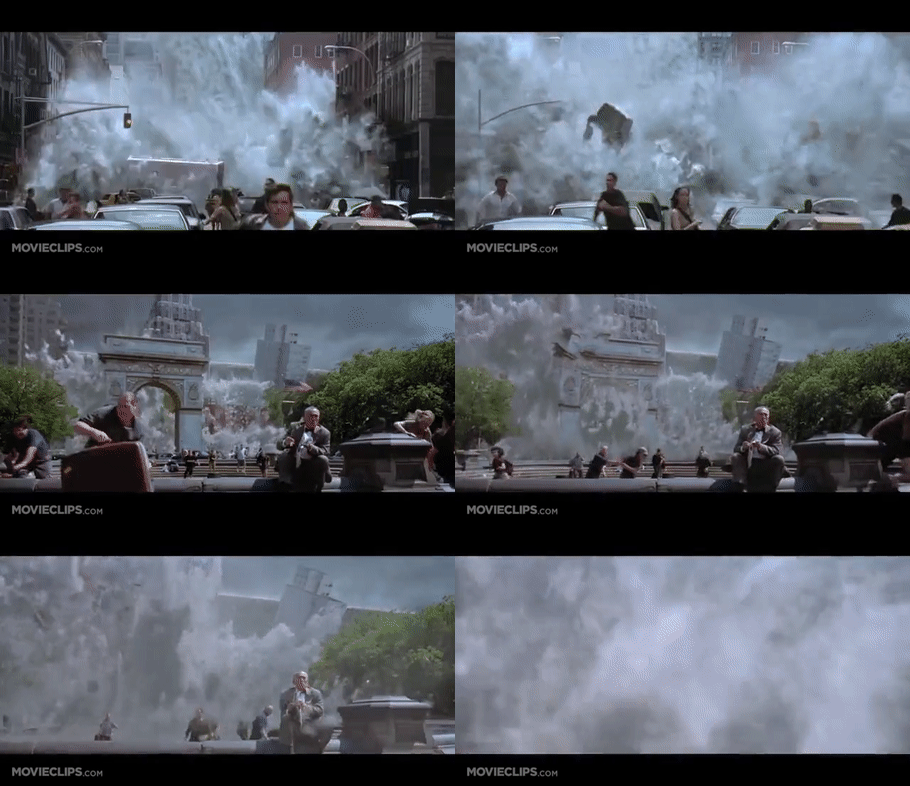
2004’s science fiction film The Day After Tomorrow had too many catastrophic waves to share. The waves are the result of a global meteorological disaster; the sudden cooling of the North Atlantic ocean circulation. It is based on the 1999 book The Coming Global Superstorm which explores how global warming might produce sudden and catastrophic climate change.
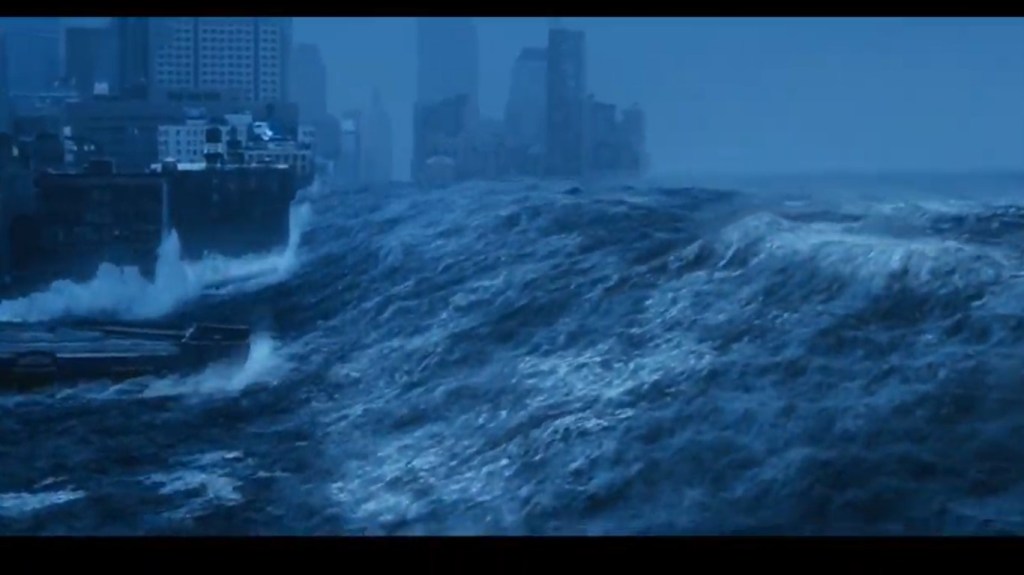
This is from the movie 2012 which, ironically, came out in 2009. The earth’s crust has become unstable and the planet is headed towards extinction. This particular wave is pouring over the Tibetan mountain tops. If you remember, based on the Mayan calendar, 2012 was a year marked as the end date to a 5,126-year-long cycle. This movie is a loose homage to that prediction.
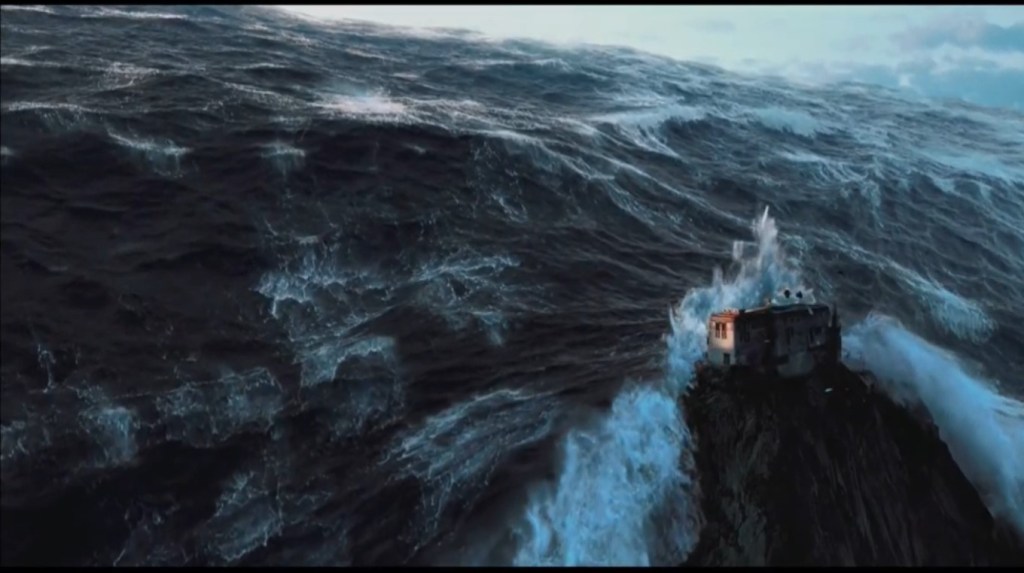
I caught The Wave (2015) on Netflix a few years ago. It was Norway’s first foray into the full-scale disaster genre. It’s premise is that a large crevasse falls into a fjord triggering a 260 foot (80 m) wave. The wave and its speed was impressive.


 Leavingthedooropen.com
Leave a reply to Victoria Cancel reply