Back in the mid-1990’s, I remember shopping one day in a Best Buy. There were rows of boxes lined all the way down the aisle; stacked on slanted display shelves for easy title viewing. Each box held a compact disc; a disc which might become the perfect game for our shiny new computer.
“Should I get Myst? King’s Quest? Pinball?” I thought happily as I perused the aisles. Suddenly, a box caught my eye. The block letter label said IQ (Intelligence Quotient) Test. I wish I could remember more about it, but I remember the instant inspiration I felt.
I was intrigued. This new era of technology was ushering in a vast landscape of opportunity.
“I should try to market an IQ Test” I thought (literally from nowhere.)
“I think people are interested in what their IQ score might be and don’t know how to go about getting it,” I added.
With crazy optimism in my eyes, I contacted an old college friend of mine (who reads this blog!) and picked her fabulous brain about my idea. Trust me. She’s the one in college who requested extracurricular homework. I think one project was translating an English novel into French; just for fun. She’s amazing and funny as hell, too.
Obviously, there was one compact disc on the market already. Was there room for more? What about working with someone to develop an online site? Home computer sales were sky-rocketing (dare I say “into the clouds”?) for the average consumer, and an online site would be even easier to access.
We both did a little research (she found a separate test from mine) and she asked good questions. Soon, I realized that the idea wasn’t new and computer technology was; for operating systems and search engines. It would be a technical Mount Everest to climb. It was not the right fit for me.
And so, I moved on and forgot all about that whimsical dream; until I recently rediscovered my dad’s obituary. One line caught my eye:
“He served in the Army during the Korean War, where he administered psychological tests to prisoners of war.”
“Oh My God, I had forgotten this,” I realized. “I know about those tests. They were IQ tests.”
Soon after graduating from college, the army drafted my dad to serve in the Korean War (now identified as a Conflict). It was mandatory because Congress had enacted the Universal Military Training and Service Act in 1951. All men between the ages of 18 and 35 would enlist for approximately 24 months.
They never trained him on the front line because he didn’t pass the eye test and he was a college graduate. Instead, they trained him to administer psychological tests to North Korea prisoners of war.
With the language barrier, part of this testing relied heavily on the visual. Dad used the Kohs Block Test to determine their IQs. This test consisting of 17 cards with colored patterns and 16 painted blocks. Test takers needed to replicate the designs on the cards using the painted blocks (each side was a single color or two colors divided by a diagonal line). Each round grew increasingly difficult. He timed the tests as part of the final scoring.

Samuel C. Kohs created this test in the 1920s, and by the 1930s, it was being given to both children and adults. It was first administered at the Ohio School for the Deaf, and at other schools with special needs students. The Kohs Block Test has been adapted through the years and is still used to measure “executive function and learning.”
Well, my dad brought those blocks home from South Korea and pulled them out years later to see if I wanted to take the test. I did. I clearly remember the blocks and the colors on them. They were yellow, red, blue and white. He sat off to the side, writing the occasional note and looking at his watch.
I also remember questions. Apparently, if a prisoner spoke English, I guess my dad used the questions besides the blocks. I have the vaguest recollection of one question about a fire in a movie theater, but that’s it. It’s possible I was around 10 or 11. I must have felt quite grown-up going through the test.
After reading the obituary again, I understood, for the first time, exactly why I was so keenly interested in “giving” IQ tests. My father had done the exact same thing. It’s a belated version of “I want to be just like my dad when I grow-up.” It was like a thumbprint gently leaving its mark in malleable clay.
I love that. I love that, unbeknownst to me, I carried that experience for twenty-five years and didn’t know it until the Best Buy test awakened it; even though I still did not connect it to my dad for another 30. It’s like a “new” connection with him; bonding over IQ testing. That makes me happy.
I’ve shared two stories about my dad’s alcoholism. The truth is that those struggles belie the fact that he was a highly intelligent person. Academics and study came easily and were his focus. Apparently, this wasn’t enough for an alpha father who had been a winning college coach and wanted him in sports as well, but that is definitely a story for another time. He graduated from Dartmouth College with honors. I wouldn’t be surprised to learn that his own IQ was probably up there.
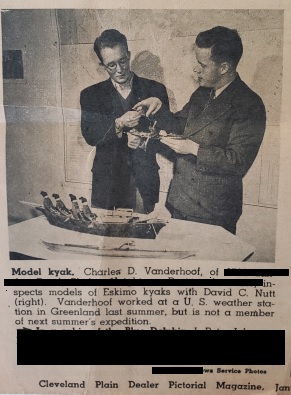
In 1948, he was selected for a prestigious summer appointment at the U.S. Weather Bureau in Thule, Greenland and sailed there from Boston. He was 21 years old. This achievement reminds me he once held much promise in this world. I like that too. (Four years ago, I transcribed his diary from this trip. Part I of that story is here. Part II follows that.)
In terms of testing, I recognize IQs are just a number and there can be errors in the processing. Emotional Quotients (EQs) Tests exist now as well, which measure how well you manage your emotions and communicate with others. If any of this helps people to feel more secure in the world, or confident that they have some excellent skills to use in life, I’m all for it. Just search Amazon for “Koh’s blocks.” New variations of them and testing remain popular.
And on a personal level, I’m just in awe that I can see the thread now between my experience growing up and that powerful pull in my 30s to repeat it. It was not “literally from nowhere” after all. A parent’s imprint holds such a tremendous influence.
Courtesy Blocks photo: Worthpoint
Reference: Wikipedia


 Leavingthedooropen.com
Leave a reply to petespringerauthor Cancel reply