My family will gather soon to say goodbye to my mom. It has been a month now since she passed, which is impossible to believe.
I looked back at my blog and counted 40 posts written about her and the challenges of how to help an aging parent. Documenting the many situations and solutions was the constant thread through all those stories.
As I reviewed them, though, I realized something. I understood what I was trying to do when I wrote them, but on these pages, her life begins at age 87. Her story starts at the end and I never shared the beginning. So I’m turning the theme upside-down. The following is a unique look at my mom; the woman who was once light years away from being an aging parent.
Her name was Gretchen Grauer, and she was born in 1930 to well-known Cleveland artists and teachers William C. Grauer and Natalie Eynon Grauer. I found an old newspaper interview from the 1950’s sharing a tiny glimpse into her childhood.
“Her memories of a bohemian childhood are some of her fondest. There was the Fine Arts Studio (in Cleveland) where a young Gretchen rode her tricycle up and down aisles of artists practicing their craft. And there were glorious summers at the Greenbrier Hotel near Charleston, where her father taught art classes while painting murals at the legendary hotel.”
Yes, mom spent most of her summers as a young girl living at The Greenbrier Resort in White Sulphur Springs, West Virginia, while her parents taught classes there. The history of this stunning, famous resort runs so deep, I cannot do it justice here.
Some may be familiar with its name because of the famous secret “bunker” once built there, which was exposed in 1992. It had been a U.S. government “relocation facility” to house Congress in the event of a nuclear war. Buried 720 feet into a hillside and attached to the Greenbrier, its location remained a secret for 30 years. (This was many years after my mother’s time there.)
On July 12, 2016, I had an informal oral history sit-down with mom about her summers at the Greenbrier. Hers was a truly unique experience, and I wanted to put her thoughts in writing. I didn’t know then that dementia was right around the corner. I am thrilled I did it.
Here is a partial interview about her summers as a child:
How did the Greenbrier affiliation begin?
“Rorimer-Brooks Company was a well-known Cleveland interior decorating business started by Louis Rorimer. His company was hired to redecorate the Greenbrier Resort sometime around 1929 or 1930. Rorimer had already worked with daddy (Bill) when he hired him for the Kansas City Club murals. This led to his involvement at the Greenbrier. It included painting the murals as well as the start of the art school and the gallery.”
How did the art school and gallery work?
“The art school was on Alabama Row. This was part of the Cottage Row section, which was separate from the main hotel. Guests at the resort were welcome to visit the art colony at any time to paint, draw or attend classes taught by several visiting artists.
The gallery was set-up in the hotel. It was called the Old White Art Gallery; it showcased the students’ work. Resident artists teaching at the school could also exhibit there. Some famous artists teaching there included Russell Barnett Aitken, who was a sculptor and the enamelist Ed Winters. Henry Keller and Rockwell Kent also taught there. They all held exhibitions there, including my parents, of course. Both my parents ran the Summer Art Colony and the Gallery.”
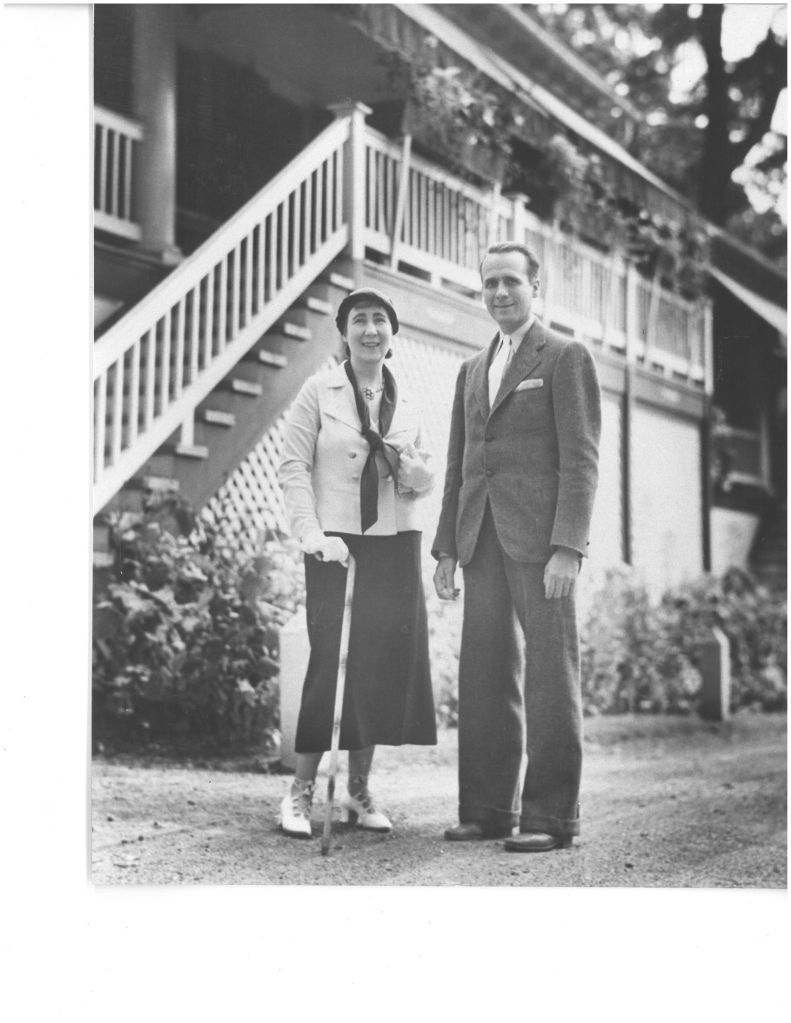
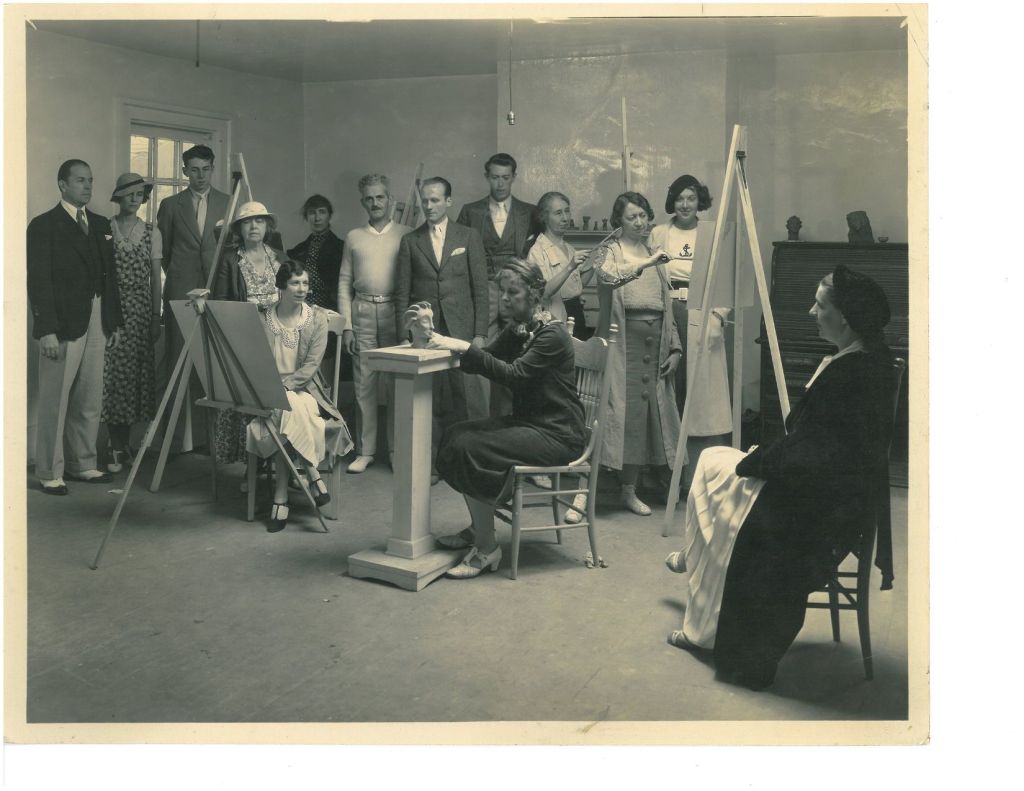
What was it like to be a young girl staying at this famous resort every summer?
“For many years, we had a cottage near the hotel. I had a nanny because classes lasted all day. They weren’t formal classes, really. Students were encouraged to walk in for advice and Bill was often seen heading out on location to one of the hundreds of beautiful scenes on that property. But one or both of my parents always came back to the cottage during the day to check in.
I kept busy. Sometimes, I went to the Greenbrier polo games. I played with some of the children of the hotel’s guests.
(One of those playmates was “Sunny” Crawford, who later became the heiress and socialite who married Claus von Bülow.)
There was a children’s gift store down by the cottages that had all kinds of fabulous toys, big bears, anything that a child would love. It was fine for me to go in and look, but the toys were very expensive and I never actually bought anything.
Every night, we would walk over and have dinner at the hotel. Mother made me dresses, including the popular Kate Greenaway dress. (She was a character from a well-known children’s book.) I didn’t really like it though. I hated the nylon. It wasn’t comfortable. I even attended the children’s Costume Ball every year, which included balloons, music and food. It was probably held at 5:00 in the afternoon!”
When did it end?
“World War II ended my parent’s time at the Greenbrier. I think it closed for six years once the war started. I do remember that the cottages used by the Art Colony eventually got taken over by the government for a hospital.”
This story almost feels surreal to me. But it happened.
In 2000, when I was turning 40 and mom was turning 70, our family planned a milestone visit to the Greenbrier in order to see the work of my grandfather in person. He created the murals still appearing in the Virginia Room and the Presidential Cottage Museum. Wow, the history was palpable.
Those early years were formative. Gretchen spent a lot of her life promoting her father’s artwork and being by his side at gallery functions, etc. Right after college, she worked for the Newspaper Enterprise Association, placing color in their comic strips. She married and had my sister and I.
She dabbled in painting, but her strength was having an excellent eye for design and fashion, which served her well in chic retail positions. She always dressed impeccably. We lost my father in 1978 and she never remarried. She lived alone for the next 40 years.
Watching her own mother as a co-director both at the Greenbrier and as a city college art teacher, I know that ideas of equality and a certain level of confidence were instilled at a very young age. Her astrological sign was Leo, the sign of the lion, and that suited her perfectly. In fact, her mother and she had birthdays only a day apart. I think that dual dynamic absolutely influenced her and the raising of her daughters – the next generation. Piece all that together, and it is a portrait of a strong, modern woman. It’s quite a life we will be celebrating.

PostScript Thought:
Who in your life has a story to tell? Hold a conversation (or several) and write or record their words, whether it is a friend, a sister or a spouse. I don’t think it has to be limited to young and old. I can only share that it is uniquely comforting to end up with the documented words of a loved one.


 Leavingthedooropen.com
Leave a reply to jsbates Cancel reply