When early stories of a new virus were breaking last February into March, I remember a nursing home being hit hard in Washington State and I remember people being stuck on cruise ships around the world because no country wanted to give them port of entry.
But what resonated with me the most at that time were the stories coming out of Italy. The case numbers and nightmarish death totals grew every day. I saw unsettling photos of coffins lined up in churches; there was nowhere else to put them. I remember the jets flying over their citizens, spraying out a trail of the colors of the Italian flag; and those same citizens singing from their balconies. It was very moving.
But Italy was pulling at my heartstrings for another reason too: one of my oldest and dearest friends is Italian. Born and raised in Naples, I met Giovanna de Conciilis when she attended college in the United States. We both hoped that she might stay after graduation and that we would rent an apartment in New York City and lead exciting lives.
Her family, however, had other plans and wanted her home; which she ultimately wanted too. But over the next 40 years, we remained friends and traveled to see each other as well as meet up in neutral locations such as Mexico. So, it was no surprise that I was highly alarmed hearing about her country and I messaged her about her status. This was her very first response regarding the new, mysterious and deadly Coronavirus.
March 20: “Hello…we are all safe so far. Very strange situation…always home except for work 3 times a week…no social life at all, video chats with my girlfriends and phone calls…we are very careful, do groceries once a week and walks with the dog with my sister for 30 minutes. I don’t want to scare you but it is better to be on the very safe side! When you go grocery shopping, I would wear a mask and gloves to be disposed of when you get home. The peak in Naples is yet to come…”
And that was how it started. Over the next several months, we talked and messaged with each other regularly.
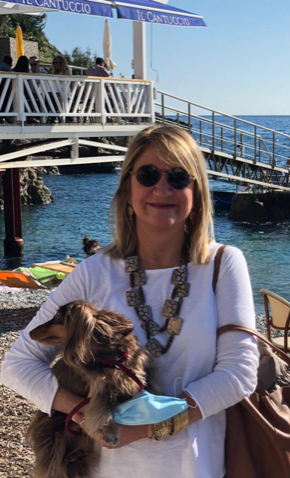
By summer, it seemed like Italy was a success story. Many restrictions were lifted and Italians vacationed (mostly within their own country) and for the most part, resumed their lives.
And then the second wave hit. Sometime in November, I saw on our national news that there were riots in Naples. Residents were pushing back against a second lockdown. I contacted her immediately about this story.
“What is going on with the rioting Gio?” I asked. “Naples is in our news. Did fights break out? Why is this happening?”
“No, there was no fighting, but there were riots in the streets with some windows broken, it was mostly about people who are losing a lot of money with shops and businesses closed” she began.
“There are also lots of people who do “black” work, meaning they do not pay taxes or declare their income so they cannot be “helped” by the government. But we also have to take into consideration that a lot of our economy is “black.” And that means that if they do not work, or cannot be helped, many people will fall into poverty or into the hands of the low lives (criminals) and affect the local economy. Anyway, there was only one episode before our county governor took some steps back in order not to exacerbate them more!” she concluded.
It was this conversation that gave me the idea to begin sharing her point-of-view and experiences regarding the pandemic. With her permission, I pieced together past conversations as well as sent her questions which she recently answered for me.
“You are in a second lockdown right now” I began. “Tell me some specific rules that are in place for residents.”
“This lockdown is much softer, we are allowed to walk and go about, most shops are closed but some are open and there are many things you can buy besides food. We cannot go out between 10 pm-6 am unless we have serious or work reasons to do so, but people are mostly very responsible. We cannot go to a cafe shop or a restaurant because they can only sell take away food.”
And then Gio added “Contrary to the first lockdown, we are all more conscious of the illness and what it implies and this is a little scarier.”
“How many people do you know have had the virus?” I asked. “Has anybody you know passed away from it?”
“Many friends have had it, or their sons or daughters, most of them have come out of it with little problems, although some of them were not very far from going into the hospital which is seen as a no-no” Gio stated “both because it means you are very sick, and also because of the proximity to others. And more than anything, because of the loneliness.”
“In a house” she continued “you can be isolated but you know there is someone you love very close and you can talk even if thru a door, in the hospital you are on your own and can only rely on medics and paramedics who are doing their job! No close friends have died but I know of a few people – friends of friends that did die. It is scary.”
“Have there been any announcements regarding how Naples will handle Christmas?” I inquired.
“Christmas in Italy this year will be a sad and lonely Christmas for our people who usually gather in crowds of at least 14 for the night of the 24th and the day of the 25th. We have been highly recommended to keep the dinner and lunch to immediate family and no more than 6! Apparently, Carlo (Carlo is her son who lives and works in Switzerland) could not even come here but that will be overcome since he still has a residency in Italy. The government told us that it cannot come into our homes and sanction us but we are all kindly asked to follow the rules. In Italy, this will mean that at least 70% will follow the rules… the rest I cannot assure!”
“Ok. Hoarding has been a huge issue in the States. It lightened up for a while, but is back. Is hoarding a problem in Naples?”
“No, never has been” Gio quickly replied.
“In the first lockdown there were queues by supermarkets since only a few people could shop at the same time, now there are no such restrictions but for the mask and your temperature taken as you walk in.”
“You have continued to go into work as a private banker since Day One. What precautions do they have there?” I asked.
“We only work by appointment. We have also been given masks, sanitary liquid for hands, a device for temperature and have a plexiglass separation on our desks. We are asked not to be in full force at work, and have smart (remote) working once a week from home. I am not worried to go to work, on the contrary, I’m grateful to have something to do considering I am used to going out every day and I am always full of energy” Gio responded.
“Have you been tested for the virus? If yes, did you feel like you had symptoms?”
“I did take a blood test in mid-September just to see if I had any “contacts”, but no, my IgGs and IgMs were at zero. No more tests since then since I lead a semi-secluded life.”
“I am not familiar with those terms “IgGs and IgMs”. Can you explain?” I asked.
“Of course. It is a medical indication that tells you if you are in the middle of Covid or if you once had Covid and have developed antibodies. It actually works for all infections.”
(I was fascinated by this and dug a little further. “IgG” and “IgM” are short for Immunoglobulin G (IgG) and Immunoglobin M (IgM). Immunoglobins are different classes of proteins found in the cells of the immune system, and function as antibodies. The IgG is the most common type of antibody and the IgM is found mainly in the blood and lymph fluid. It’s the largest antibody and the first to be made by the body to fight a new infection.)
“You referenced Carlo earlier. He lives in Switzerland. Are you “comfortable” with their Covid policies? Remind me what you said you sent to him as a precaution.”
“I am comfortable to the extent that Switzerland is known to have an excellent sanitary program BUT as of now they have almost more cases than we do so it is not very clear what would happen if my son had to be hospitalized for the virus. In any case I sent him medicines and antibiotics that are usually used to cure the virus in the unfortunate case that he gets it and gets it badly!”
“Can you clarify what you mean by cure?”
“Of course. From what we know, and we know a lot reading and hearing of people, as soon as you get the virus, before you get really sick and to avoid hospitalization (at all costs, possibly) you must start being very aggressive with the virus, which means taking antibiotics and cortisone so that the virus does not have a big chance to invade all of your body. This way symptoms can be lessened. This does not mean that you won’t fall very sick, but it is believed that it helps a lot, even for the unfortunate circumstance of catching pneumonia which is a very common output of the virus. Apparently, cortisone fights well for the body.”
And Gio became passionate as she brought up the vaccine.
“And of course, the vaccine will give immunization, but as of right now we don’t have them available. When it does become available, then sadly, there will be the controversy of who wants to do it and who thinks it’s not safe and those no-vax people really, really anger me.”
“Yes, I understand. That resistance will slow the eradication of the virus. We also have people who don’t believe in, or are scared of the vaccine and don’t plan on taking it. Our media keeps saying “trust the science” but there is still skepticism. My thinking is that people would want to get back to normal and the vaccine is the way to get there. What do you want to get back to the most?” I asked in conclusion.
“Well, after work, I used to go downtown and see friends and have a tea or a drink. And on the weekends, we always used to go out to dinner at a restaurant or a friend’s house or at the movie theater or to the theater…it’s all gone. I cannot see people anymore and I miss that more than anything else!”
I plan to keep in touch with Giovanna to see how the roll-out of the vaccine is in Naples. And although video-chatting is nice, I look forward to the time when the distance between us is only across a table.. perhaps inside an Italian restaurant.
Photo: NYC 1981. A photographer from The News World took our photo for a story on the return of the mini-skirt.


 Leavingthedooropen.com
Leave a reply to Two Years In…Whatever Happened To? – Leaving The Door Open Cancel reply