It was mid-September when I sent a text checking in with my sister and she replied “We’re with mom at the hair salon and she says hi.”
This is how I learned that restrictions had been relaxed for my 90-year-old mother Ginny who had been in lockdown inside her senior living residence for 186 days. (Click here for previous post). After all this time, she was suddenly out. Free.
Almost immediately, residents were getting picked up (and driving themselves) for Target trips, family visits and grocery runs. The automatic doors never had a chance to close.
New policies for dining in the dining room took a little longer. In fact, it was an additional month before they transitioned back to communal dining from bringing separate meals to each resident. Ultimately, they chose to seat two at a table, at staggered times. Each resident received a time that remained the same all week. Then it reset for the following week.
Rotating the “better” times was a fair approach, but Ginny’s memory is not good, so the downside was that she missed several meals. I do think that there have been times where she showed up and they sat her regardless of her time.
And staff also opened up visitation for one family member per resident at a time. The caveat was that it be for no more than 30 minutes. Hope for growing normalcy was definitely in the air.
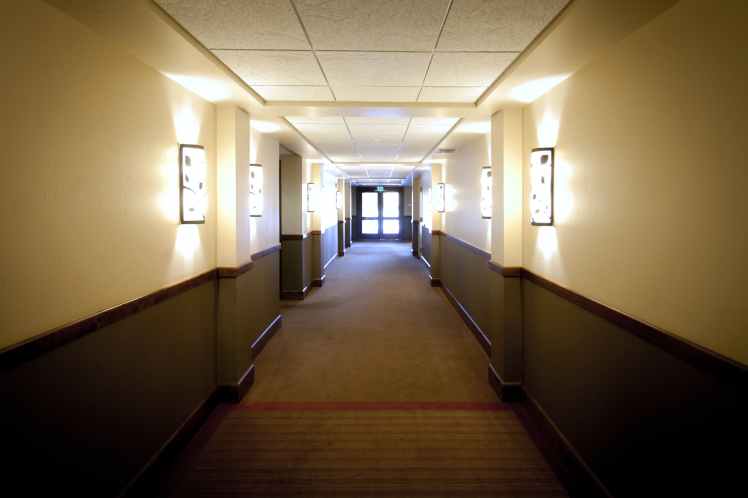
About two weeks ago, however, that hope was compromised in a couple of different ways. On a recent afternoon, Ginny forgot that she was getting out into the world for a hair appointment. When she was reminded that my sister-in-law Betsy (who lives close to Ginny and offered to take her) was waiting for her outside the lobby doors, she rushed downstairs, moving too quickly down a long hallway and fell. Hard. She hit the floor with the back of her head and somehow (I haven’t been able to determine her moves exactly) scraped her chin badly.
Four staff members rushed over to assist. Typically, they will first ask the resident if they want an ambulance (as many decline) but they didn’t ask. They just called 911. It must have looked bad. Ginny told me later that she kept saying “my head hurts, my head hurts.”
As they took her stretcher to the ambulance, Betsy was still waiting for her, paying no attention to the activity behind her.
Suddenly, she heard “Betsy” and turned around to see my mom being placed inside. A round of phone calls immediately began.
The emergency room staff took good care of her. They did a CT scan of her head and X-rayed her arm and leg, and there were no broken bones. At 90, that is a flat-out miracle. She told me that she had pretty good bumps on her head and arm though. She also received five stitches in her chin.
I am still unable to drive the 2-3 hours to see her because of COVID fears. I just completed cancer treatment in the early fall and am still high risk; as is she. It was an anxious afternoon waiting for updates. She didn’t leave until the evening so I called the following morning.
“Mom, how do you feel? Can you describe to me what happened?” I asked.
“Well, I’m ok, I guess. I think my shoes stuck on the floor” she offered. “They stopped and I didn’t” she added, laughing weakly. “The next thing I know, I’m surrounded by people like a flock of birds all hovering around my head.”
We continued talking and I was deeply relieved that she was coherent; providing good descriptions. But I’ll be honest. I still fear the fall may potentially trigger some type of delayed secondary consequence. A few days later, she mentioned that she had a long bruise practically all around her neck. It frightened her, but has since faded.
And within that time span between the fall and trying to get her hair done again (she was still healing and wary of going), internal COVID policies shifted once more with new rules. Sadly, state case numbers had begun to rise; substantially.
When I spoke with Ginny one morning, she mentioned a “wild” announcement she had heard that morning that they couldn’t leave their rooms at all now. She was frustrated that it would be “worse than before.”
I received more clarity later that day. She was half-right. Instead of going on full lockdown this time, the new policy states that a resident can go “off-site” as long as it is considered essential. This includes medical, the grocery store or the drive-up window at the bank. If they leave for a non-essential reason such as hair or nail appointments or holiday shopping, they will need to self-quarantine for 14 days after their return. Meals would be brought to them in that time period. Or, they can quarantine for five days and take a COVID test at their cost. Each time the resident leaves for a non-essential visit, the self-quarantine procedure resets.
In addition, the staff is strongly suggesting that residents not leave the premises to see their families for the holidays, but they are not blocking it either. In addition to the self-quarantine rule, they (and the family they are visiting) must sign a pledge stating that they will practice the following steps to ensure their safety. It lists hand-washing, avoiding large groups, social distancing, stay outside as much as possible etc.
It’s clear that the new policies favor the choice to stay in since quarantines sound cumbersome; and lonely. Who wants to stay in their unit for 14 days? Or even 5? In lockdown, mom was at least free to roam the buildings, go to the library, check her mail etc.
But I also feel like, this time, they are walking a fine line. Previously, the full lockdown prohibited social interaction and physical connection with families which, in some cases, played a role in declining health. Now, they are placing the decision on the resident and the family, deciding what works best for their loved one. It gives both of them some control back.
It’s difficult, but that feels like the right call to me. The very latest I have heard is that the CDC is considering changing the quarantine length from 14 days to 7-10 days. Perhaps this will trickle down to the local level.
Over the past nine months, there have been so many changes layered on top of already exhausting changes. I continue to be astonished at the strength of the human spirit to endure the countless sacrifices so patiently.
Ginny has asked me so many times when I am coming over and I gently remind her that I’m afraid of the risk of the virus and she replies “Oh that’s right. I forgot” and moves on with the conversation. Between COVID and cancer treatments, it has now been a year since I’ve seen her.
Against a backdrop of COVID, her fall has also reminded me of the fragility of life and how quickly it could change. Christmas would be such a normal, visceral way to reunite, but normalcy is retreating once again. It feels like another type of long hallway that seems to keep extending. But we must all get through it safely before we can embrace our old lives again.
Photo by Binyamin Mellish on Pexels.com


 Leavingthedooropen.com
Leave a reply to Anonymous Cancel reply