UPS delivered the package on Saturday evening, December 16th, at 6:00 p.m. The return address was The IU School of Medicine. This was not a Christmas present.
When I saw it, I like to think that it was my last “yes” capping off my year of experimentation of trying instead of denying new things in my life. I already knew its contents.
Three years ago, the medical laboratories company Quest Diagnostics contacted me. (I once used Quest for various blood draws and a bone scan, which is how they got my information.)
They emailed inquiring whether I would want to take part in future clinical trials if my stats matched the study. I agreed, but so much time had passed, I had completely forgotten about it.
It was surprising to hear from them on December 6th. The subject line was “Volunteer for a Michael J. Fox Foundation Health aging study.”
The email continued:
“Our sense of smell plays an important role in monitoring brain health as we age. In fact, smell loss may be one of the most important signals of risk for Parkinson’s disease.”
“The Michael J. Fox Foundation is exploring this link in its landmark study. The Foundation and partners launched the Parkinson’s Progression Markers Initiative (PPMI) in 2010.”
“Quest Diagnostics is working with the Foundation to offer you the opportunity to join this study. PPMI is asking every U.S. citizen, age 60 and older without Parkinson’s to take a scratch-and-sniff test.”
There it was; the reason they chose me. It was a simple one. I was over 60 and did not have Parkinson’s. I’m sure thousands and thousands of emails went out with this request. So, this was my “out” to say no. I assured myself that they would easily get the numbers they needed. I was just keeping a crazy December schedule and didn’t want to get involved. My mind started stepping backwards. Thankfully, my curiosity held firm.
I searched online about this connection between smell loss and Parkinson’s, as well as the validity of the PPMI organization and Quest. It was all legitimate. In fact, I found a fascinating article in Scientific American about a Scottish woman who can sniff out people with Parkinson’s disease. I realize that sounds incredulous. Here is a small portion:
“A Scottish woman named Joy Milne made headlines in 2015 for an unusual talent: her ability to sniff out people with Parkinson’s disease, a progressive neurodegenerative illness that is estimated to affect about 10 million people worldwide. Since then, scientists in the U.K. have been working with Milne to pinpoint the molecules that give Parkinson’s its distinct olfactory signature. They have now zeroed in on a set of molecules specific to the disease—and created a simple skin-swab-based test to detect them.”
“Milne has hereditary hyperosmia, a condition that gives her hypersensitivity to smell. She discovered she could smell Parkinson’s after noticing her husband, Les, was emitting a new, musky odor. When he was diagnosed with Parkinson’s many years later, she linked this change in scent to the disease.”
Scientists put Milne through many tests, and they proved successful. Enough so that the Michael J. Fox organization wanted to pursue and fund further studies in the field.
I returned to the link in the email I was reviewing. They would snail mail me the test with the scratch-and-sniff patches and questions. I would subsequently enter my answers online. The research portion was being run through Indiana University.
Well, it certainly sounded straight-forward enough, and I realized I needed to say “yes.”
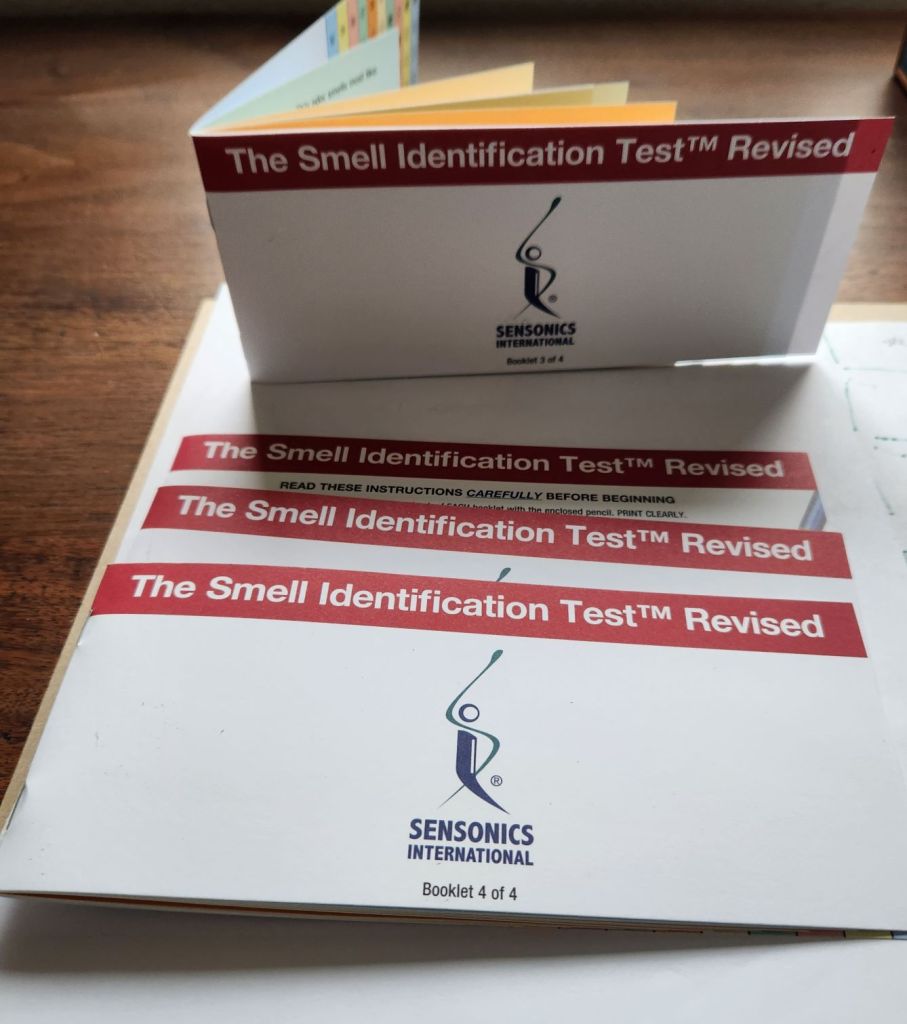
It took about ten days for the test kit and instructions to arrive. There were four booklets, each containing ten questions each, and a pencil. They labeled the booklets with numbers 1-4. They instructed me to take the pencil and scratch the small, brown patch at the bottom of each page. I needed to scratch it left to right several times to release the odor. Then, they offered four choices to choose from.
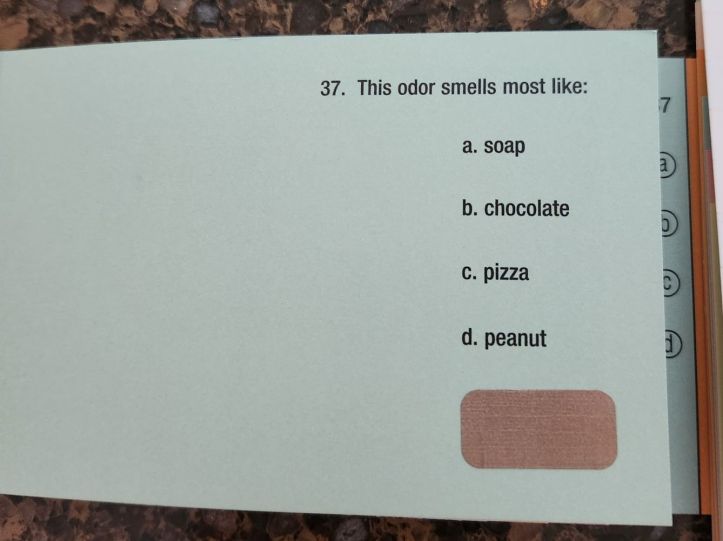
If the odor that I smelled was not a choice, I needed to choose the closet match. All 40 questions needed an answer to be successful.
I had created an account with PPMI, so the next step was to log in and use the unique ID code they provided on the cover page to enter my results. I just followed the answers I marked with the pencil and filled them in again on the online version.
I don’t want to over-share my results on what I specifically smelled, but some were instant answers. A few were difficult. Some choices were red herrings; they were never part of the 40 answers. Here are a few random choices to provide an idea of what smells they created:
Peach
Smoke
Black Pepper
Raspberry
Onion
Cotton Candy
My mind wandered a bit as I considered how they can create or mix chemicals to reproduce smoke or cotton candy odors. It was quite interesting to me.
The instructions included the fact that the PPMI team may contact me after they review my answers. They may invite me to complete additional tests at a designated site. They cover all travel costs for those volunteers.
Of course, now that I am vested in the project, I hope they will reach out. Realistically, however, I don’t think that I am a “super-sniffer” like Milne. But I’m okay being part of the chaff if it helps to reach the wheat. It’s a numbers game and I fervently hope they find the specific volunteers they need. Finding a way to diagnose the disease at an early stage is everything. What a different world it could be for Parkinson’s patients.
Read the full Scientific American article HERE:


 Leavingthedooropen.com
Leave a comment